
Imagine you’re finishing a busy workday when your phone rings. You answer politely, only to hear someone asking for a person you’ve never met. In situations like this, saying “You have the wrong number“ quickly clears up the misunderstanding. Although the phrase is simple, the way you say it can influence how polite, professional, or helpful you sound. Whether you’re responding to a business call, replying to a text message, or correcting someone in an email, choosing the right wording helps avoid confusion while maintaining positive communication. Understanding its meaning and knowing suitable alternatives can improve everyday conversations, workplace interactions, and digital communication.
What Does “You Have The Wrong Number” Mean?
“You have the wrong number” is a straightforward expression used to tell someone they have contacted an incorrect telephone number or messaging account. It informs the caller or sender that the person they intended to reach is unavailable because they have dialed or selected the wrong contact information, helping prevent further confusion.
Origin & History of “You Have The Wrong Number”
The phrase “You have the wrong number” emerged alongside the widespread adoption of telephone networks during the late nineteenth and early twentieth centuries. As telephone ownership increased, accidental misdialing became common because callers manually entered numbers or relied on human telephone operators to complete connections.
Early telephone etiquette guides encouraged people to respond courteously when receiving unintended calls. Instead of abruptly ending the conversation, people would simply explain that the caller had reached the incorrect number. This practical response gradually became standardized across English-speaking countries.
As technology evolved from rotary phones to mobile devices and internet-based messaging, the phrase remained remarkably consistent. Today, it appears not only in voice conversations but also in text messages, messaging apps, customer support chats, and even automated responses.
Its meaning has also expanded slightly. In modern communication, it may refer to:
- An incorrect phone number
- A mistaken text message
- Contacting the wrong person
- Messaging the wrong account
- Reaching an unintended recipient
Despite technological changes, the phrase continues to represent one of the clearest and most universally understood ways to correct mistaken communication.
Synonyms & Alternatives by Tone
Professional & Neutral Alternatives
- I believe you’ve reached the wrong contact.
- This isn’t the person you’re trying to reach.
- You’ve contacted the incorrect number.
- I think you’ve reached the wrong recipient.
- This phone number isn’t associated with that person.
- I’m afraid you’ve dialed incorrectly.
Polite & Supportive Alternatives
- Sorry, I think you’ve got the wrong number.
- I don’t believe this is the correct contact.
- I hope you find the right person.
- It seems there’s been a mix-up.
- I think you’ve contacted the wrong person.
Encouraging & Reassuring Alternatives
- No worries, mistakes happen.
- You may want to double-check the number.
- Perhaps the contact information is outdated.
- You might want to verify the phone number.
- I hope you’re able to reach them soon.
Casual, Playful & Idiomatic Alternatives
- Wrong person!
- I think you meant someone else.
- Oops, wrong number.
- Looks like you texted the wrong person.
When Should You Use “You Have The Wrong Number”?
Using “You have the wrong number” is appropriate whenever you need to correct mistaken contact clearly and respectfully. The phrase works because it immediately identifies the problem without blaming the caller or creating unnecessary embarrassment.
Professional Settings
In workplaces, customer service, healthcare, or business communications, the phrase helps redirect callers efficiently.
Examples include:
- Answering business phone calls
- Responding to clients who contacted the wrong employee
- Correcting customer inquiries
- Receiving mistaken recruitment calls
- Replying to business text messages
A slightly softer alternative such as “I believe you’ve reached the wrong contact” may sound even more professional.
Casual Conversations
Friends and family frequently receive accidental calls or texts. In these situations, a friendly response usually works best.
For example:
“Hi! I think you’ve got the wrong number.”
This sounds helpful rather than dismissive.
Writing, Presentations, and Digital Communication
Although the phrase primarily appears in conversations, it also fits written communication, including:
- Emails
- SMS messages
- Slack
- Microsoft Teams
- Customer support chats
- Contact form replies
A written version should remain concise and courteous.
Example:
“Hello! I believe you’ve reached the wrong number. I hope you’re able to contact the intended recipient.”
When It Is Especially Effective
The phrase works particularly well when:
- Someone repeatedly calls the wrong contact.
- A stranger accidentally texts you.
- A client contacts the wrong department.
- A recruiter emails the wrong candidate.
- A delivery driver contacts an unintended customer.
- Customer support receives an incorrect inquiry.
Its strength lies in its clarity, allowing both parties to quickly move on without confusion.
When Should You Avoid “You Have The Wrong Number”?
Although the phrase is usually appropriate, there are situations where a different response communicates more effectively.
Overly Formal Situations
In highly formal business correspondence or executive communication, saying “You have the wrong number” may sound overly direct.
Instead, consider:
- “I believe you’ve reached the incorrect contact.”
- “I’m afraid this isn’t the appropriate point of contact.”
These alternatives maintain professionalism while sounding more diplomatic.
Legal, Academic, or Sensitive Contexts
If the conversation concerns legal matters, healthcare, financial information, or confidential issues, avoid giving brief responses that might seem dismissive.
A more suitable reply might be:
“I’m sorry, but you’ve reached someone else. Please verify the contact details before sharing any confidential information.”
This protects both parties.
Situations Where Nuance May Be Lost
Text messages lack vocal tone, so “You have the wrong number.” may appear cold or unfriendly.
Instead, adding a small courtesy improves the interaction:
“Hi! I think you’ve got the wrong number. Hope you find the right person.”
The additional sentence makes the response feel noticeably warmer.
Is “You Have The Wrong Number” Professional, Polite, or Casual?
The phrase “You have the wrong number” is generally considered neutral. Its professionalism depends largely on delivery, context, and tone of voice rather than the words themselves.
Formality Level
It falls in the neutral-to-semi-formal range.
It is appropriate for:
- Business calls
- Customer support
- Everyday conversations
- Emails
- Text messages
For executive communication or official correspondence, a slightly softer alternative often sounds more polished.
Emotional Subtext
The phrase itself carries very little emotional weight. It simply communicates a factual correction.
However, tone can completely change how it is perceived.
Compare these examples:
- “You have the wrong number.” (neutral)
- “Sorry, I think you’ve got the wrong number.” (friendly)
- “You’ve reached the incorrect contact.” (professional)
- “Wrong number.” (abrupt)
The surrounding words matter as much as the phrase itself.
Audience Perception
Different audiences may interpret the phrase differently.
- Customers generally appreciate a polite explanation.
- Colleagues prefer professional wording.
- Friends expect a relaxed tone.
- Older callers may appreciate additional courtesy.
- Younger users often favor shorter, conversational responses.
Adapting your wording to your audience demonstrates effective communication skills.
Pros and Cons of Using “You Have The Wrong Number”
Advantages
Clarity
The phrase immediately communicates that the caller or sender has contacted the wrong person, leaving little room for misunderstanding.
Efficiency
It resolves accidental communication quickly, allowing both parties to continue without wasting time.
Accessibility
The wording is simple, widely understood, and suitable for native speakers, ESL learners, professionals, and casual users alike.
Universally Recognized
Across English-speaking regions, the phrase is familiar and requires no explanation, making it effective in both spoken and written communication.
Potential Drawbacks
Tone Mismatch
Without a polite introduction or closing, the phrase can sound abrupt, especially in text messages where vocal cues are absent.
Oversimplification
In customer service or professional settings, a more detailed explanation may better guide the other person to the correct contact.
Repetition
People who frequently receive spam calls or misdirected messages may rely on the phrase repeatedly, making interactions feel mechanical or impersonal over time.
Missed Opportunity to Help
If you happen to know the correct contact or department, simply saying “You have the wrong number” may not be the most helpful response. Offering brief guidance can create a more positive interaction.
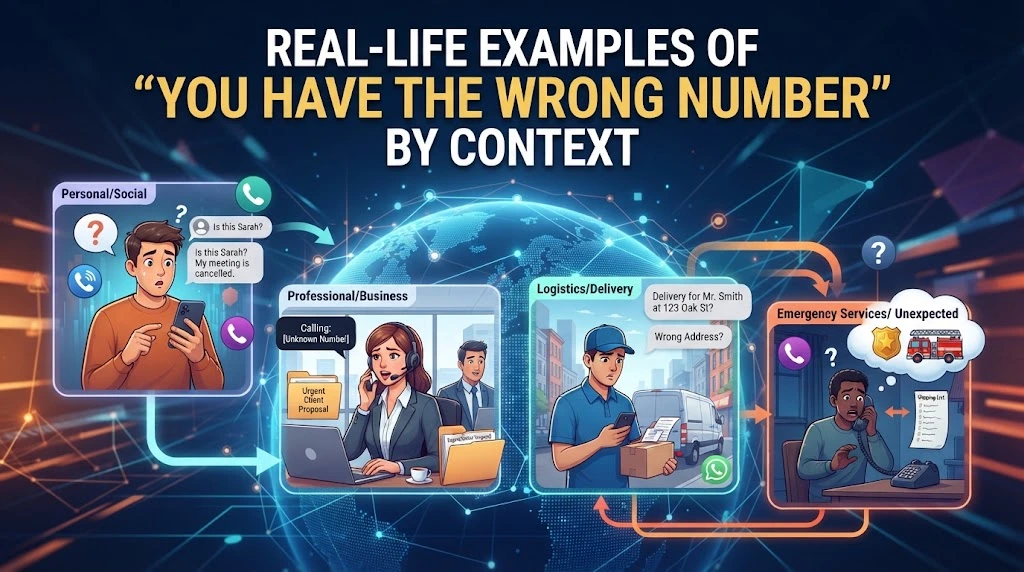
Real-Life Examples of “You Have The Wrong Number” by Context
Understanding how “You Have The Wrong Number” is used in everyday situations helps you choose the most natural wording. The examples below reflect realistic conversations across professional and personal settings.
Emails
Example 1
Hello Sarah,
I believe you’ve reached the wrong contact. I’m not responsible for the marketing department, but you may want to check the company directory for the correct email address.
Best regards,
Daniel
Why it works: It politely corrects the mistake while remaining professional and helpful.
Meetings
Example 2
During a virtual meeting, someone addresses the wrong participant.
“I think you may have the wrong person. Emma handles that project, not me.”
Why it works: It redirects the discussion without embarrassing anyone.
Presentations
Example 3
A presenter accidentally attributes a statistic to the wrong department.
“I believe there’s been a small mix-up. That information actually belongs to the Finance team.”
Why it works: It corrects the mistake diplomatically while keeping the meeting productive.
Conversations
Example 4
Caller:
“Hi, is Michael available?”
Receiver:
“Sorry, you’ve got the wrong number.”
Why it works: It is short, polite, and immediately resolves the misunderstanding.
Social Media
Example 5
Someone sends a direct message intended for another account.
“Hey! I think you meant to message someone else. This isn’t the right account.”
Why it works: The response is friendly and avoids making the sender feel awkward.
Text Messages
Example 6
Unknown Sender:
“Are we still meeting at 7?”
Reply:
“Hi! I think you’ve got the wrong number. Hope you find the right person.”
Why it works: Adding a friendly sentence softens what could otherwise sound abrupt.
Customer Service
Example 7
Customer:
“I’d like to cancel my reservation.”
Representative:
“I believe you’ve reached the wrong department. Let me direct you to the reservations team.”
Why it works: Instead of ending the conversation, it helps solve the caller’s problem.
“You Have The Wrong Number” vs Similar Expressions (Key Differences)
Choosing the right alternative depends on your audience, the situation, and the level of politeness you want to convey.
| Phrase | Meaning Difference | Tone Difference | Best Use Scenario |
| You have the wrong number | Indicates the caller or sender contacted an incorrect phone number. | Neutral and direct | Everyday phone calls and text messages |
| I think you’ve reached the wrong person | Focuses on contacting the incorrect individual rather than just the number. | Friendly and conversational | Business emails, messaging apps, workplace chats |
| You’ve contacted the incorrect recipient | Refers broadly to reaching the wrong destination, including email or messaging platforms. | Formal and professional | Corporate communication and official correspondence |
| I believe you’ve reached the wrong contact | A softer, more diplomatic correction. | Professional and courteous | Customer service, executive communication |
| This isn’t the person you’re trying to reach | Emphasizes mistaken identity rather than the phone number itself. | Warm and reassuring | Personal conversations and customer interactions |
| I think you meant someone else | Suggests an accidental mistake without explicitly mentioning the number. | Casual and friendly | Social media, texting, informal chats |
Key takeaway: While all of these expressions communicate a similar idea, their tone ranges from formal to casual. Choosing the right wording helps maintain professionalism and encourages positive communication.
Common Mistakes & Misuse of “You Have The Wrong Number”
Although the phrase is simple, people sometimes use it in ways that reduce clarity or unintentionally sound rude.
Overusing the Phrase
Repeatedly replying with the same wording can make conversations feel robotic, especially if you frequently receive spam calls or misdirected texts.
Instead of always saying:
“You have the wrong number.”
Try varying your response:
- “Sorry, I think you’ve got the wrong number.”
- “I believe you’ve reached the wrong contact.”
- “I don’t think this is the person you’re looking for.”
Using It in the Wrong Context
The expression specifically relates to mistaken contact.
Avoid using it when:
- Someone misunderstood your point.
- Someone made a factual mistake.
- A colleague misunderstood instructions.
- An email contains incorrect information rather than being sent to the wrong recipient.
In these situations, phrases like “I think there’s been a misunderstanding” are more appropriate.
Sounding Too Abrupt
A one-line reply can appear unfriendly.
For example:
“Wrong number.”
Although technically correct, it lacks warmth.
Compare it with:
“Sorry, I think you’ve got the wrong number.”
The second version is usually perceived as much more polite.
Assuming Bad Intent
Receiving an unexpected call doesn’t necessarily mean someone is being careless.
Common reasons include:
- Old contact information
- Typing errors
- Autocomplete mistakes
- Saved numbers from previous owners
- Outdated business directories
Responding politely acknowledges that honest mistakes happen.
Cultural Misunderstandings
In some cultures, direct communication is appreciated.
In others, indirect wording is considered more respectful.
For international communication, adding a brief apology or friendly closing often creates a better impression.
Psychological Reasons People Prefer “You Have The Wrong Number”
The popularity of “You Have The Wrong Number” isn’t accidental. Several communication principles explain why people naturally choose this expression.
Cognitive Load Reduction
The human brain prefers messages that require minimal interpretation.
“You have the wrong number” immediately answers two questions:
- What happened?
- What should I do next?
Because the meaning is obvious, it reduces mental effort for both people.
Trust and Authority Signals
Clear language often appears more credible.
Rather than offering a long explanation, the phrase simply presents a factual correction.
This straightforwardness increases trust because it avoids unnecessary detail.
Attention Economy
Modern communication happens quickly.
People often answer calls while:
- Working
- Driving (hands-free)
- Shopping
- Commuting
- Multitasking
A concise phrase respects everyone’s limited attention.
Predictability
Many native speakers have heard this phrase countless times.
Its familiarity means listeners instantly recognize the situation without further explanation.
Conflict Avoidance
Instead of blaming the caller
“You dialed incorrectly.”
the phrase focuses on the situation itself.
This subtle wording reduces defensiveness and helps conversations end positively.
US vs UK Usage of “You Have The Wrong Number”
Both American and British English commonly use “You Have The Wrong Number.” However, slight differences in style and tone exist.
Popularity
The phrase is extremely common in both countries.
Whether someone uses a mobile phone, landline, or messaging app, native speakers immediately understand it.
Tone Perception
United States
Americans generally view the phrase as neutral.
Short responses such as:
“Sorry, wrong number.”
are common and rarely considered impolite.
United Kingdom
British speakers often soften the message slightly.
Examples include:
- “Sorry, I think you’ve got the wrong number.”
- “I’m afraid you’ve reached the wrong person.”
These versions align with the UK’s preference for indirect politeness in many everyday interactions.
Regional Preferences
| Region | More Common Style |
| United States | Direct and concise |
| United Kingdom | Slightly softer and more indirect |
| Canada | Friendly and polite |
| Australia | Relaxed and conversational |
Despite these differences, the meaning remains identical across English-speaking countries.
“You Have The Wrong Number” in Digital & Modern Communication
The phrase has evolved alongside communication technology.
Emails
In professional emails, people often choose slightly more formal alternatives.
Example:
“I believe you’ve reached the wrong contact.”
This sounds more polished than simply saying:
“Wrong number.”
Slack and Microsoft Teams
Workplace messaging platforms favor concise yet polite communication.
Example:
“I think you’ve reached the wrong person. The Operations team can help with this.”
This not only corrects the mistake but also redirects the sender.
WhatsApp and SMS
Text messaging benefits from warmth because tone can easily be misunderstood.
Instead of:
“Wrong number.”
Many people prefer:
“Hi! I think you’ve got the wrong number. Hope you find the right person.”
Social Media
Accidental direct messages are common.
A friendly correction prevents awkwardness.
Example:
“I think you meant to send this to someone else.”
AI-Generated Summaries and Chatbots
Modern AI systems increasingly recognize context.
Rather than repeating the literal phrase, AI often uses more conversational alternatives such as:
- “It appears you’ve contacted the wrong person.”
- “This doesn’t seem to be the intended recipient.”
- “You may want to verify the contact information.”
These responses maintain clarity while sounding natural.
Linguistic & Communication Insight
Understanding “You Have The Wrong Number” goes beyond its dictionary definition. Native speakers interpret not only the words themselves but also the tone, context, and social intent behind them.
Emotional Weight & Subtext
On the surface, the phrase simply corrects an error. Emotionally, however, it can signal patience, irritation, helpfulness, or indifference depending on delivery.
A calm, friendly voice suggests understanding:
“Sorry, you’ve got the wrong number.”
A curt response:
“Wrong number.”
may unintentionally communicate annoyance, even if none was intended.
Direct vs Indirect Phrasing
The phrase is relatively direct because it identifies the mistake immediately.
Indirect alternatives include:
- “I don’t think you’ve reached the right person.”
- “There may have been a mix-up.”
- “I believe you’ve contacted the wrong recipient.”
These versions soften the correction and can reduce embarrassment, especially in professional or cross-cultural communication.
Professional Communication Perspective
In workplace environments, language choices influence how others perceive your professionalism.
A brief correction is efficient, but offering a little guidance often creates a stronger impression.
For example:
“I believe you’ve reached the wrong contact. The HR department should be able to assist you.”
This approach solves the immediate problem while demonstrating courtesy and cooperation.
Pragmatic Reasons for Alternatives
Experienced communicators often choose alternative wording because they understand that how a message is delivered is just as important as the message itself.
Softer phrases can:
- Reduce defensiveness.
- Encourage continued dialogue.
- Show empathy.
- Preserve professional relationships.
- Improve customer experience.
The best communicators adjust their wording to suit the audience rather than relying on a single fixed phrase.
Social Signaling
Word choice subtly communicates personality and attitude.
A helpful response suggests:
- Professionalism
- Patience
- Respect
- Emotional intelligence
A blunt response may unintentionally signal impatience or disinterest, even when the information is accurate.
These social cues shape first impressions and influence how future interactions unfold.
Tone & Context Guidance
There is no universally perfect version of “You Have The Wrong Number.” The most effective wording depends on who you’re speaking to, the communication channel, and the level of formality required.
As a general guideline:
- Use direct language when speed and clarity are most important.
- Use softer alternatives in customer service, business communication, or sensitive situations.
- Add a brief apology or helpful suggestion when appropriate to create a more positive interaction.
Mastering these subtle choices allows you to communicate clearly while maintaining trust, professionalism, and courtesy.
I believe you’ve reached the wrong contact.
Meaning: This phrase politely informs someone that they have contacted an unintended person or department. It is commonly used in professional communication when redirecting inquiries.
Why This Phrase Works: “I believe” softens the correction, making it sound courteous rather than abrupt. It maintains professionalism while clearly communicating the mistake.
Real-World Usage Insight: Receptionists, customer support representatives, HR professionals, and office staff frequently use this wording because it corrects the situation without making the other person feel embarrassed.
Best Use: Business emails, customer service, workplace phone calls, and formal messaging.
Avoid When: Close friends or family are texting, where the phrase may sound overly formal.
Tone: Professional, polite, and diplomatic.
US vs UK Usage: Common in both the US and UK. British English may favor this slightly more because of its indirect style.
Example (Email):
Hello James, I believe you’ve reached the wrong contact regarding your invoice. Our Finance team will be happy to assist you using the email address listed on our website.
This isn’t the person you’re trying to reach.
Meaning: This expression explains that the recipient is not the individual the sender intended to contact.
Why This Phrase Works: It focuses on correcting the misunderstanding without assigning blame. The wording feels approachable and reassuring.
Real-World Usage Insight: Native English speakers often use this phrase when responding to mistaken text messages or calls from strangers.
Best Use: Phone calls, text messages, social media messages, and casual workplace conversations.
Avoid When: Highly formal legal or executive correspondence where more formal wording is expected.
Tone: Friendly, neutral, and helpful.
US vs UK Usage: Equally natural across both varieties of English.
Example (Message):
Hi! This isn’t the person you’re trying to reach, but I hope you’re able to get in touch with them soon.
You’ve contacted the incorrect number.
Meaning: This phrase directly states that the phone number or messaging account reached is not the intended one.
Why This Phrase Works: The wording is concise and precise, making it ideal when clarity is the highest priority.
Real-World Usage Insight: Businesses sometimes use this wording in automated replies or voicemail recordings because it leaves little room for misunderstanding.
Best Use: Automated customer service responses, voicemail greetings, and professional communication.
Avoid When: Casual conversations, where it may sound stiff or impersonal.
Tone: Formal, factual, and neutral.
US vs UK Usage: Widely understood in both countries, although everyday speakers often prefer simpler alternatives.
Example (Message):
Thank you for your message. You’ve contacted the incorrect number. Please verify the contact information before trying again.
I think you’ve reached the wrong recipient.
Meaning: This phrase indicates that a message has been sent to someone who was not meant to receive it.
Why This Phrase Works: Using “recipient” broadens the phrase beyond phone calls, making it useful for emails, messaging platforms, and collaboration tools.
Real-World Usage Insight: Professionals frequently use this wording when responding to emails that were accidentally sent to the wrong colleague.
Best Use: Email, Slack, Microsoft Teams, and other workplace communication platforms.
Avoid When: Everyday phone conversations where “wrong number” sounds more natural.
Tone: Professional and courteous.
US vs UK Usage: Common in business English on both sides of the Atlantic.
Example (Email):
Hello Emily, I think you’ve reached the wrong recipient. I’m not involved with this project, but the Operations team should be able to assist you.
This phone number isn’t associated with that person.
Meaning: This phrase explains that the requested individual does not use the current phone number.
Why This Phrase Works: It provides slightly more information than simply saying “wrong number,” helping prevent repeated attempts.
Real-World Usage Insight: This wording is especially useful when someone repeatedly calls asking for the previous owner of a phone number.
Best Use: Repeat callers, customer inquiries, and mistaken personal contacts.
Avoid When: You do not wish to reveal any information about the ownership of your phone number.
Tone: Informative and neutral.
US vs UK Usage: Equally common in both American and British English.
Example (Phone Call):
I’m sorry, but this phone number isn’t associated with that person anymore. You may want to check whether you have the correct contact details.
I’m afraid you’ve dialed incorrectly.
Meaning: This expression politely informs someone that they entered or selected the wrong telephone number.
Why This Phrase Works: Beginning with “I’m afraid” softens the correction, making it sound considerate rather than blunt.
Real-World Usage Insight: Older generations and customer service professionals often favor this traditional wording during voice calls.
Best Use: Telephone conversations, reception desks, and formal customer interactions.
Avoid When: Text messages or social media, where it can sound unnecessarily formal.
Tone: Formal, respectful, and courteous.
US vs UK Usage: More common in British English, though fully understood in American English.
Example (Phone Call):
I’m afraid you’ve dialed incorrectly. The person you’re trying to reach doesn’t use this number.
Sorry, I think you’ve got the wrong number.
Meaning: This friendly variation tells someone they have contacted the wrong phone number while immediately expressing courtesy.
Why This Phrase Works: Starting with “Sorry” demonstrates empathy and acknowledges the inconvenience, making it feel more human.
Real-World Usage Insight: This is one of the most frequently heard responses in everyday English because it balances clarity with kindness.
Best Use: Everyday phone calls, text messages, WhatsApp conversations, and personal communication.
Avoid When: Formal business documents or official correspondence.
Tone: Friendly, polite, and conversational.
US vs UK Usage: Extremely common in both countries, although British speakers tend to use “Sorry” even more frequently in routine interactions.
Example (Text Message):
Hi! Sorry, I think you’ve got the wrong number. I hope you’re able to reach the person you’re looking for.
I don’t believe this is the correct contact.
Meaning: This phrase gently suggests that the sender has contacted someone who cannot assist with their request.
Why This Phrase Works: It sounds cooperative rather than dismissive, encouraging a positive interaction even when correcting an error.
Real-World Usage Insight: Professionals often use this wording when redirecting inquiries to another department or colleague instead of simply ending the conversation.
Best Use: Business emails, customer support, workplace messaging, and professional networking.
Avoid When: Speaking with close friends or family, where the wording may feel overly formal.
Tone: Professional, supportive, and diplomatic.
US vs UK Usage: Natural and widely accepted in both the US and UK, particularly in business communication.
Example (Email):
Good morning. I don’t believe this is the correct contact for your request. Our Customer Success team will be able to assist you more effectively.
I hope you find the right person.
Meaning: This phrase acknowledges that the caller or sender has contacted the wrong person while expressing goodwill. It focuses more on the outcome than the mistake itself.
Why This Phrase Works: It ends the interaction on a positive note. Rather than simply pointing out the error, it shows empathy and leaves a friendly impression.
Real-World Usage Insight: Native speakers often add this sentence after explaining that someone has the wrong number. It softens the conversation, especially with strangers.
Best Use: Text messages, phone calls, social media, and customer service interactions.
Avoid When: Responding to spam, scams, or persistent unwanted callers who do not require further engagement.
Tone: Warm, encouraging, and polite.
US vs UK Usage: Common and natural in both American and British English.
Example (Message):
Hi! I think you’ve got the wrong number. I hope you find the right person soon.
It seems there’s been a mix-up.
Meaning: This expression suggests that a misunderstanding or accidental mistake has occurred without placing blame on anyone.
Why This Phrase Works: It frames the situation as a simple error rather than someone’s fault, making the conversation feel more collaborative.
Real-World Usage Insight: Professionals frequently use this phrase when correcting misunderstandings in emails, meetings, or customer support conversations.
Best Use: Business communication, meetings, customer service, and professional emails.
Avoid When: Immediate clarity is needed, such as emergency calls where direct wording is more effective.
Tone: Diplomatic, professional, and reassuring.
US vs UK Usage: Widely used across both regions, particularly in workplace communication.
Example (Meeting):
It seems there’s been a mix-up. I believe this request was intended for another department.
I think you’ve contacted the wrong person.
Meaning: This phrase politely explains that the sender has reached someone other than their intended contact.
Why This Phrase Works: It is easy to understand and works across phone calls, emails, messaging apps, and social platforms.
Real-World Usage Insight: This is one of the most versatile alternatives because it isn’t limited to phone numbers. It suits modern communication where people often connect through multiple platforms.
Best Use: Email, LinkedIn, WhatsApp, Slack, and text messaging.
Avoid When: Automated responses or formal legal communication requiring greater precision.
Tone: Friendly, neutral, and professional.
US vs UK Usage: Equally common in both countries.
Example (Email):
Hello Rachel, I think you’ve contacted the wrong person regarding your project proposal. You may want to reach out to our Product team instead.
No worries, mistakes happen.
Meaning: This reassuring phrase comforts the other person after an accidental call or message.
Why This Phrase Works: Instead of focusing on the error, it emphasizes understanding and reduces any embarrassment the sender may feel.
Real-World Usage Insight: Native speakers commonly use this phrase when responding to accidental text messages or calls from strangers.
Best Use: Casual conversations, messaging apps, and friendly customer interactions.
Avoid When: Formal business correspondence or situations requiring strict professionalism.
Tone: Relaxed, kind, and reassuring.
US vs UK Usage: Very common in both the US and UK, especially among younger speakers.
Example (Message):
No worries, mistakes happen! I think you’ve got the wrong number. Hope you reach the right person.
You may want to double-check the number.
Meaning: This expression encourages the caller or sender to verify the contact information before trying again.
Why This Phrase Works: It doesn’t merely point out the mistake—it offers practical guidance that helps solve the problem.
Real-World Usage Insight: Customer service representatives often use this wording because it provides a clear next step.
Best Use: Phone support, emails, customer service chats, and business communication.
Avoid When: The caller is already aware of the mistake and doesn’t need additional instruction.
Tone: Helpful, professional, and constructive.
US vs UK Usage: Common throughout English-speaking countries.
Example (Phone Call):
I believe you’ve reached the wrong contact. You may want to double-check the number before calling again.
Perhaps the contact information is outdated.
Meaning: This phrase suggests that the caller may be using old or inaccurate contact details.
Why This Phrase Works: It offers a logical explanation for the mistake without implying that anyone was careless.
Real-World Usage Insight: This wording is especially useful when a business has changed phone numbers or when someone inherits a previously assigned mobile number.
Best Use: Business communication, customer inquiries, and repeat mistaken contacts.
Avoid When: You know the mistake was simply a typing error rather than outdated information.
Tone: Professional, thoughtful, and informative.
US vs UK Usage: Natural and widely understood in both American and British English.
Example (Email):
Hello, perhaps the contact information is outdated. Our office has recently updated its phone number, so you may wish to verify your records.
You might want to verify the phone number.
Meaning: This phrase recommends checking the phone number to ensure it is accurate.
Why This Phrase Works: It provides a constructive suggestion instead of ending the interaction with a simple correction.
Real-World Usage Insight: Businesses often include similar wording in automated replies and customer support messages to reduce repeated mistakes.
Best Use: Customer support, voicemail messages, and professional communication.
Avoid When: Speaking with close friends, where a simpler response sounds more natural.
Tone: Professional, courteous, and solution-oriented.
US vs UK Usage: Frequently used in both the US and UK.
Example (Message):
I don’t think you’ve reached the right person. You might want to verify the phone number and try again.
Wrong person!
Meaning: This short expression immediately tells someone they’ve contacted someone other than the intended recipient.
Why This Phrase Works: Its brevity makes it ideal for fast-paced digital conversations where people prefer concise replies.
Real-World Usage Insight: Friends often use this phrase in texts, direct messages, or group chats after receiving an accidental message.
Best Use: Informal texting, social media, and messaging apps.
Avoid When: Professional emails, workplace communication, or conversations requiring diplomacy.
Tone: Casual, direct, and lighthearted.
US vs UK Usage: Very common among younger speakers in both countries.
Example (Social Media):
Wrong person! I think you meant to send that message to someone else.
I think you meant someone else.
Meaning: This phrase gently suggests that the sender intended to contact another individual.
Why This Phrase Works: It focuses on the intended recipient rather than emphasizing the mistake, making it sound friendly and approachable.
Real-World Usage Insight: This alternative is widely used in messaging apps, social media, and everyday conversations because it feels natural and conversational.
Best Use: Text messages, Instagram, Facebook Messenger, WhatsApp, and casual workplace chats.
Avoid When: Official business correspondence where greater precision is preferred.
Tone: Friendly, conversational, and reassuring.
US vs UK Usage: Equally common in American and British English.
Example (Message):
Hi! I think you meant someone else. I’m not the person you’re trying to reach.
Oops, wrong number.
Meaning: This playful expression lets someone know they have contacted the wrong phone number in a lighthearted way.
Why This Phrase Works: The word “Oops” immediately creates a relaxed atmosphere and reassures the sender that the mistake is minor.
Real-World Usage Insight: Native speakers commonly use this phrase when replying to accidental texts between strangers, particularly when the situation is harmless or amusing.
Best Use: Casual text messages, personal chats, and social media conversations.
Avoid When: Professional settings, customer service, legal matters, or formal workplace communication.
Tone: Playful, informal, and friendly.
US vs UK Usage: Popular in both the US and UK, especially in everyday digital communication. It is more common in texting than in spoken business conversations.
Comparison Table of 10 Best Alternatives
The alternatives below are the most versatile replacements for “You Have The Wrong Number.” They balance clarity, politeness, and professionalism, making them suitable for a wide range of personal, workplace, and digital communication scenarios.
| Phrase | Meaning | Best Use | Worst Use | Tone | US vs UK Usage |
| I believe you’ve reached the wrong contact. | Politely indicates the recipient is not the intended contact. | Business emails, customer support | Casual texting with friends | Professional | Common in both; slightly more common in UK business English |
| Sorry, I think you’ve got the wrong number. | Politely tells someone they contacted the wrong number. | Phone calls, SMS, WhatsApp | Legal or official documents | Friendly | Extremely common in both the US and the UK |
| I think you’ve reached the wrong recipient. | Explains the message was sent to the wrong person. | Email, Slack, Teams | Casual phone conversations | Professional | Widely used in both regions |
| This isn’t the person you’re trying to reach. | Clarifies mistaken identity. | Personal conversations, customer service | Automated responses | Friendly | Common in both US and UK |
| I think you’ve contacted the wrong person. | Indicates the sender has reached someone unintended. | Email, messaging apps | Legal correspondence | Neutral | Equally common in both countries |
| It seems there’s been a mix-up. | Suggests a misunderstanding without assigning blame. | Meetings, workplace communication | Emergencies requiring immediate clarity | Diplomatic | Popular in both the US and UK |
| You may want to double-check the number. | Encourages verifying contact details. | Customer service, business calls | Casual chats with friends | Helpful | Common across English-speaking regions |
| I hope you find the right person. | Ends the interaction with encouragement. | Personal texts, customer support | Scam or spam responses | Warm | Frequently used in both the US and UK |
| I think you meant someone else. | Suggests the message was intended for another person. | Social media, texting | Formal business communication | Casual | Very common in both regions |
| Wrong person! | Quickly points out mistaken identity. | Friends, messaging apps | Professional communication | Informal | Common in digital communication across both countries |
Conclusion
“You Have The Wrong Number” is one of the simplest yet most useful phrases in everyday English. Whether you’re answering a mistaken phone call, responding to an accidental text, or redirecting a business inquiry, it communicates the situation clearly and efficiently. However, the exact wording you choose can influence how polite, professional, or approachable you appear.
In formal settings, softer alternatives such as “I believe you’ve reached the wrong contact” create a more polished impression, while casual expressions like “Sorry, I think you’ve got the wrong number” feel warm and conversational. By understanding the phrase’s meaning, tone, and context, you can respond appropriately in any situation. Choosing language that matches your audience not only avoids confusion but also strengthens communication, demonstrates emotional intelligence, and leaves a positive impression in both personal and professional interactions.
FAQs
What does “You Have The Wrong Number” mean?
It means the caller or sender has contacted an incorrect phone number or messaging account. The intended person cannot be reached through that contact because the information used is incorrect or outdated.
Is “You Have The Wrong Number” considered polite?
Yes. The phrase is generally neutral and polite. Adding words such as “sorry” or “I think” makes it sound even friendlier, especially in text messages and customer service situations.
Can I use “You Have The Wrong Number” in a professional email?
Yes, although a more formal alternative often works better. Expressions like “I believe you’ve reached the wrong contact” or “I think you’ve reached the wrong recipient” sound more professional in workplace communication.
What’s the best alternative for customer service?
A helpful alternative is “I believe you’ve reached the wrong contact. Let me point you in the right direction.” This not only identifies the mistake but also assists the customer.
Is “Wrong number” rude?
Not necessarily, but it can sound abrupt because it lacks context or courtesy. Adding a brief apology or friendly closing usually creates a more positive interaction.
What’s the difference between “Wrong number” and “Wrong person”?
“Wrong number” refers specifically to an incorrect phone number, while “Wrong person” can apply to phone calls, emails, text messages, or any situation where the intended recipient is someone else.
Do Americans and British people use this phrase differently?
Both use it regularly. Americans often communicate more directly, while British speakers may soften the wording with phrases like “I’m afraid” or “I think you’ve got the wrong number.”
Can AI or chatbots use this phrase naturally?
Yes. AI assistants frequently use variations such as “It appears you’ve reached the wrong recipient” or “You may want to verify the contact information” because they sound clear, polite, and conversational.
Why is tone important when saying “You Have The Wrong Number”?
Tone influences how your message is received. A polite, friendly response reduces embarrassment, maintains professionalism, and encourages respectful communication, while an abrupt reply may seem dismissive.
Which alternative is the most professional?
“I believe you’ve reached the wrong contact” is one of the strongest professional alternatives. It is clear, respectful, and suitable for emails, business calls, customer service, and workplace messaging.